A finding is only useful when you can see the evidence.
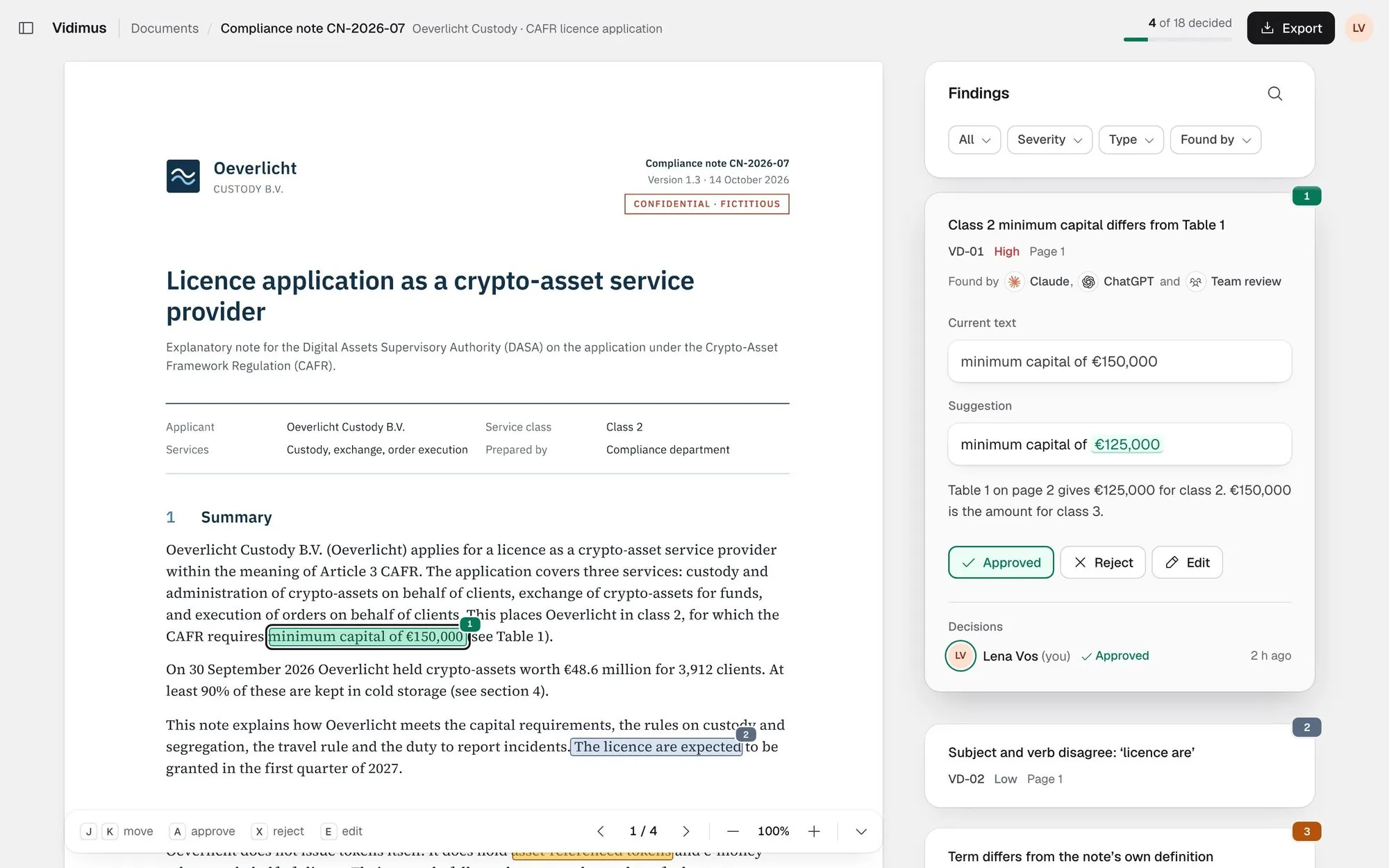
Vidimus brings document analysis into a review desk built around the original PDF. It connects potential errors to the relevant passage, puts explanations and suggested corrections beside the source, and keeps the final decision with the reviewer.
Public demo; full-stack application in development
The review desk
The document stays at the center.
Long reports can hide inconsistencies in figures, terminology and references that a spelling check will miss. Vidimus connects a finding to a precise location in the PDF. Instead of jumping between exported notes and the original document, the reviewer can read the evidence, assess the suggested change and move to the next item in one place.
The review, start to finish: the tools mark the note, one overview lists the findings, a person decides each one.
A long document.
Is everything in it right?
OeverlichtCUSTODY B.V.
Compliance note CN-2026-07 Version 1.3 · 14 October 2026 CONFIDENTIAL · FICTITIOUS
Licence application as a crypto-asset service provider
Explanatory note for the Digital Assets Supervisory Authority (DASA) on the application under the Crypto-Asset Framework Regulation (CAFR).
Applicant
Oeverlicht Custody B.V.
Service class
Class 2
Services
Custody, exchange, order execution
Prepared by
Compliance department
1Summary
Oeverlicht Custody B.V. (Oeverlicht) applies for a licence as a crypto-asset service provider within the meaning of Article 3 CAFR. This places Oeverlicht in class 2, for which the CAFR requires minimum capital of €150,000 (see Table 1).
On 30 September 2026 Oeverlicht held crypto-assets worth €48.6 million for 3,912 clients. At least 90% of these are kept in cold storage (see section 4).
This note explains how Oeverlicht meets the capital requirements, the rules on custody and the duty to report incidents. The licence are expected to be granted in the first quarter of 2027.
2Scope of the application
Oeverlicht does not issue tokens itself. It does hold asset-referenced tokens and e-money tokens on behalf of clients. Before it takes any token into custody, the Compliance department assesses the issuer's prospectus.
Article 62 CAFR divides crypto-asset service providers into three classes, according to the services they provide.1 Table 1 sets out the minimum capital for each class.
Table 1 · Minimum capital by service class
Class
Services
Minimum capital
1
Advice, orders
€50,000
2
Class 1, plus custody, exchange
€125,000
3
Class 2, plus a trading platform
€150,000
Oeverlicht's fixed overheads for 2025 were €2,140,000. One quarter of that is €435,000, which is higher than the class 2 minimum.
Oeverlicht's own funds stood at €1,000,0000 on 30 September 2026, well above the requirement.
4Custody and segregation of assets
The private keys of the cold wallets are split across three locations under a 2-of-3 scheme. The company never stores it's keys in a single location.
Any difference of more than 0.5% on reconciliation is reported to the DASA within 24 hours (see section 7.2).
Because 80% of client assets are kept in cold storage, the risk of a breach of the hot wallets is limited. Oeverlicht's liquidity reserve consists of 60% deposits with two banks, 35% short-term government bonds and 15% money market funds.
5Travel rule and self-hosted wallets
Table 2 · Thresholds and reporting deadlines
Situation
Threshold
Deadline
Self-hosted wallet
from €1,000
before execution
Unusual transaction
none
within 14 days
Reconciliation
more than 0.5%
within 24 hours
Major ICT incident
none
within 4 hours
Oeverlicht reports unusual transactions to the financial intelligence unit within 30 days. See Table 3 for the full list of reporting deadlines.
6Incident reporting
Oeverlicht reports a major ICT incident to the DASA within four hours. The crypto service provider keeps a register of all incidents.
Clients are notifed within 48 hours if an incident affects their assets.
VD-05Wrong article number for the capital requirements
VD-06Arithmetic: a quarter of €2,140,000 is €535,000
VD-07Amount with one digit too many
VD-08‘It’s’ where the possessive ‘its’ is meant
VD-09Reference to a section that does not exist
VD-1080% in cold storage, where sections 1 and 4 say 90%
VD-11The parts of the reserve add up to 110%
VD-12Reporting deadline differs from Table 2
VD-13There is no Table 3
VD-14Term differs from ‘crypto-asset service provider’
VD-15Spelling: ‘notified’
VD-16The date does not exist: June has 30 days
VD-17Repeated word: ‘the the’
VD-18Decision period: 20 working days here, 25 above
VD-19Company name misspelt
OeverlichtCUSTODY B.V.
Compliance note CN-2026-07 Version 1.3 · 14 October 2026 CONFIDENTIAL · FICTITIOUS
Licence application as a crypto-asset service provider
Explanatory note for the Digital Assets Supervisory Authority (DASA) on the application under the Crypto-Asset Framework Regulation (CAFR).
Applicant
Oeverlicht Custody B.V.
Service class
Class 2
Services
Custody, exchange, order execution
Prepared by
Compliance department
1Summary
Oeverlicht Custody B.V. (Oeverlicht) applies for a licence as a crypto-asset service provider within the meaning of Article 3 CAFR. This places Oeverlicht in class 2, for which the CAFR requires minimum capital of €150,000 (see Table 1).
On 30 September 2026 Oeverlicht held crypto-assets worth €48.6 million for 3,912 clients. At least 90% of these are kept in cold storage (see section 4).
This note explains how Oeverlicht meets the capital requirements, the rules on custody and the duty to report incidents. The licence are expected to be granted in the first quarter of 2027.
2Scope of the application
Oeverlicht does not issue tokens itself. It does hold asset-referenced tokens and e-money tokens on behalf of clients. Before it takes any token into custody, the Compliance department assesses the issuer's prospectus.
5Wrong article number for the capital requirements
VD-05HighReferencePage 2
Found by Claude
Current text
Article 62 CAFR divides
Suggestion
Article 26 CAFR divides
ApproveRejectEditApprovedRejected
6Arithmetic: a quarter of €2,140,000 is €535,000
VD-06HighFiguresPage 2
Found by Claudeand Gemini
Current text
One quarter of that is €435,000
Suggestion
One quarter of that is €535,000
ApproveRejectEditApprovedRejected
7Amount with one digit too many
VD-07MediumFiguresPage 2
Found by ChatGPT
Current text
€1,000,0000
Suggestion
€1,000,000
ApproveRejectEditApprovedRejected
8‘It’s’ where the possessive ‘its’ is meant
VD-08LowLanguagePage 2
Found by LanguageTooland Team review
Current text
never stores it's keys
Suggestion
never stores its keys
ApproveRejectEditApprovedRejected
9Reference to a section that does not exist
VD-09MediumReferencePage 2
Found by Claude
Current text
(see section 7.2)
Suggestion
(see Table 2)
ApproveRejectEditApprovedRejected
1080% in cold storage, where sections 1 and 4 say 90%
VD-10HighConsistencyPage 3
Found by Geminiand Claude
Current text
Because 80% of client assets are kept in cold storage
Suggestion
Because at least 90% of client assets are kept in cold storage
ApproveRejectEditApprovedRejected
11The parts of the reserve add up to 110%
VD-11HighFiguresPage 3
Found by Claude, ChatGPTand Gemini
Current text
15% money market funds
Suggestion
5% money market funds
ApproveRejectEditApprovedRejected
12Reporting deadline differs from Table 2
VD-12HighConsistencyPage 3
Found by Team review
Current text
financial intelligence unit within 30 days
Suggestion
financial intelligence unit within 14 days
ApproveRejectEditApprovedRejected
13There is no Table 3
VD-13MediumReferencePage 3
Found by ChatGPT
Current text
See Table 3 for the full list
Suggestion
See Table 2 for the full list
ApproveRejectEditApprovedRejected
14Term differs from ‘crypto-asset service provider’
VD-14MediumTerminologyPage 3
Found by Geminiand ChatGPT
Current text
The crypto service provider keeps a register
Suggestion
Oeverlicht keeps a register
ApproveRejectEditApprovedRejected
15Spelling: ‘notified’
VD-15LowLanguagePage 3
Found by LanguageTool
Current text
notifed
Suggestion
notified
ApproveRejectEditApprovedRejected
16The date does not exist: June has 30 days
VD-16HighFiguresPage 4
Found by Team reviewand Claude
Current text
submitted on 31 June 2026
Suggestion
submitted on 30 June 2026
ApproveRejectEditApprovedRejected
17Repeated word: ‘the the’
VD-17LowLanguagePage 4
Found by LanguageTool
Current text
governance and the the custody
Suggestion
governance and the custody
ApproveRejectEditApprovedRejected
18Decision period: 20 working days here, 25 above
VD-18MediumConsistencyPage 4
Found by ChatGPT
Current text
decision period of 20 working days
Suggestion
decision period of 25 working days
ApproveRejectEditApprovedRejected
19Company name misspelt
VD-19MediumConsistencyPage 4
Found by Geminiand Team review
Current text
Oeverlight Custody B.V. declares
Suggestion
Oeverlicht Custody B.V. declares
ApproveRejectEditApprovedRejected
The agents do the tedious part.
Every finding, marked in place.
One overview, from critical errors to style.
You decide.
Every finding decided.
Never a mistake in your documents.
In every language, for every market.
Vidimus · Internal tool, made for a client
Sample data
Two kinds of checking
Models interpret. Scripts verify.
The established offline pipeline combines language-model analysis and LanguageTool with deterministic checks for figures, dates, terminology and internal consistency. Findings are organized for comparison, but model agreement is not treated as proof. The interface makes the reasoning visible so a person can approve, edit or reject what is proposed.
Different verification methods feed one human review process.
Language models
Claude
OpenAI
Gemini
Original PDF + rulesFigures, dates, references & terminology checks
→
Models & scriptsClaude, OpenAI, Gemini & LanguageTool in parallel
→
Human review deskPassage-linked evidence · Approve, edit or reject
Model agreement is not treated as proofReviewer owns every final decision
The product evolution
From a review demonstration to a connected workspace.
The public browser version demonstrates the PDF-centered review interaction with fictional documents and simulated connector states. A separate rebuild is developing real uploads, persistent reviews and provider integrations. Its capabilities should be reflected here only after they are verified in the completed application.
A readable review overview, with status and decisions in context.
Design
Design for all of your screens.
Mobile
Check findings on the move.
Each finding stays anchored to its passage even on a phone, so a reviewer can inspect the explanation, compare the suggestion and sign off away from the desk.
The result
A clearer review process: source evidence, proposed correction and human judgment together.